

Misconceptions about eyebrow transplantation - Its Time to Debunk Urban Myths with Science
In the world of aesthetic medicine, especially in internet forums, social media and word of mouth, there is a lot of misinformation and superstition about eyebrow transplantation. 5 common misconceptions about eyebrow transplantation patients are afraid of aesthetic operations, constantly postpone the process instead of gaining a permanent eyebrow architecture, or microblading to temporary solutions that damage the skin, such as eyebrow transplantation. As Istanbul Eyebrow Transplantation, we adopt a “Scientist-Myth-Buster” approach with our team led by Dr. Handan Yavuz in our Nişantaşı clinic, and we debunk these myths one by one with scientific and surgical facts.
Getting the right information when looking for eyebrow loss solutions means protecting the future of your eyebrows, the most sensitive part of your face. If you want to perform your operation with one of the old surgical methods, the suture operation, which is performed by cutting the nape of the neck. FUT Eyebrow Transplant Some urban legends, such as stitch marks or hairs growing back, can unfortunately become a bitter reality. However, when you choose modern medical technologies and experienced surgical designs, you will not experience any of these fears and myths.
One of the most common misconceptions in society is the belief that every eyebrow transplant will give the same result. However, an eyebrow design is a highly personalized art that requires the physician to work like a sculptor. The degree and direction of the eyebrow's head, body and tail to the skin are completely different from each other. Random transplants that are not based on scientific references make artificial results inevitable.
The Most Common Eyebrow Transplant Myths and Facts
Myth 1: “Transplanted Eyebrows Will Definitely Grow Upright and Like a Grass Man”
Reality: The reason for the unnatural eyebrow transplant photos that we frequently encounter on the internet is not the technique itself, but the mistakes made by the practitioner and Classic FUE Eyebrow Transplant are the limitations of short root placement in the technique. The eyebrow hairs should grow at an angle almost parallel to the skin (10-15 degrees). In the classical method, it is impossible to see the direction of the curve of the transplanted short roots, so the hairs can be placed upside down. The premium method we apply in our clinic Long FUE eyebrow transplant In the technique, since the roots are placed with long hair strands, the natural curve and angle of the hair is controlled second by second during placement and the risk of steep growth is zero.
Myth 2: “You will have swollen eyes for days after the procedure and cannot go out in public”
Reality: In the old methods with shaving and stitches, this was partially true due to the scraping of the donor area and the edema caused by the stitches. However, in the new generation unshaven Long FUE technique, your donor area (your neck) is not shaved, so there is no visual change in your hair. In addition, since long hairs are used in the transplantation area, minimal redness and micro scabs are naturally camouflaged under these hairs. Our patients can easily continue their business meetings and social life the next day.
Myth 3: “Transplanted eyebrows will completely fall out after a few years”
Reality: The follicles used in eyebrow transplantation operations are selected from the hair follicles of the nape region, which are genetically coded not to fall out. These follicles maintain their own non-shedding genetics in the new area where they are transplanted.
The shock shedding phase experienced in the first 1 month after the operation is temporary. Instead of the hairs that fall out, you will have new and bushy eyebrows that will last a lifetime starting from the 3rd month. The lifespan of the roots is as long as the lifespan of your hair.
Myth 4: “Transplanted Hairs Continue to Grow at Hair Speed for a Lifetime”
Reality: Hair follicles taken from the nape of the neck grow fast and need to be trimmed once a week for the first 1-2 years as they retain their hair character. However, over time, they adapt to the blood circulation, skin structure and hormonal environment of the transplanted area. This adaptation process is called “recipient co-adaptation” in medical language. From the 2nd year onwards, their growth rate slows down and they achieve a growth cycle very close to the natural eyebrow character.
Myth 5: “Eyebrow Transplant is a Procedure Only for Female Patients”
Reality: Eyebrow transplantation is a gender-neutral aesthetic restoration. The proportion of male patients applying to our clinic is increasing day by day. Extremely masculine, natural and permanent eyebrow designs are realized with the भीी Long FUE technique for men with scars, burn scars, genetically sparse eyebrow structure or eyebrow loss due to aging.
Biological Age Parameters of Eyebrow Transplant Operation
The age group of patients considering eyebrow transplantation determines the biological parameters that affect the planning of the operation and the speed of healing. Since skin elasticity and cell renewal rate are extremely high in young patients (20-30 years old), micro channels close within 24 hours and edema excretion is rapid. However, since hormonal fluctuations may be active in young individuals, whether the underlying cause of eyebrow loss is genetic or a temporary stress/hormone disorder should be investigated in detail.
In mature patients (50 years and older), tissue healing may be slightly slower due to the slowing of collagen production in the skin. However, donor area hair in this age group may generally be thicker and bleached. Dr. Handan Yavuz plans a homogeneous distribution according to color during the transplantation of white hair follicles, preventing the transplanted eyebrows from creating a variegated or artificial color contrast. The age factor does not constitute an obstacle to the price or feasibility of the procedure, it only requires customization of the surgical planning.
Relationship with Postoperative Laser Hair Removal and Cosmetic Procedures
One of the most common mistakes of our patients after eyebrow transplantation is the cosmetic interventions that can be made to the transplanted area. It takes an average of 6 to 12 months for the newly transplanted hair follicles to attach under the skin in the eyebrow area and establish their own vascular networks. During this critical period, procedures involving high heat and chemicals such as fractional laser, chemical peeling or laser epilation should never be performed on the eyebrow area.
Laser beams can target the stem cells of fresh hair follicles under the skin and permanently destroy them. This results in the complete loss of the eyebrows that have been laboriously transplanted. Likewise, pigmentation procedures with sharp blades, such as microblading, mechanically damage the healing fresh root beds. Before any cosmetic or dermatological intervention, it is absolutely necessary to get approval from Dr. Handan Yavuz in our Nişantaşı clinic.
Comparative Myth-Real Analysis
A brief summary of popular beliefs and the facts presented by modern medical science can be found in the table below:
| Popular Belief (Myth) | Scientific Surgical Fact (Fact) |
|---|---|
| The procedure is an extremely painful and painful process. | Thanks to local anesthesia and needle-free devices %100 ağrısızdır. |
| For transplantation, the hair must be completely shaved. | Zero shaving is applied in the Long FUE technique, the hair doesn't get cut. |
| The color of the transplanted eyebrows is different from the hair color. | Because your own nape hair follicles are used color and character are identical. |
| Microblading is more permanent and natural than eyebrow transplantation. | Microblading is temporary and the paint fades over time; the planting is lifelong and three-dimensional. |
Frequently Asked Questions
No, they do not. On the contrary, since our female patients are more conscious about facial symmetry and eyebrow design, the planning phase is much more enjoyable. Thanks to the unshaven Long FUE method, the hair is not cut, making the process extremely comfortable for our female patients.
It is extremely easy to care for transplanted eyebrows. Since they will grow as fast as hair for the first 1-2 years, it is sufficient to trim them once or twice a week with fine-tipped scissors. This process takes only a few seconds. As the growth rate slows down in the following years, the frequency of this correction will decrease.
Yes. Most of the patients who apply to our clinic are people who are looking for a permanent solution after their previous permanent makeup has faded or grayed out. The faded trace of the old tattoo is perfectly hidden thanks to the natural and dense eyebrow hairs that are planted on it.
Since the roots are taken from the nape of the neck, they initially grow at the same thickness as your nape hair. For this reason, the thinnest hair follicles (grafts) containing a single hair on the nape of the neck are selected during transplantation. Over time, they adapt to the recipient area, become slightly thinner and approach the natural eyebrow structure.
Light activities such as walking can be started the day after the operation. However, for heavy sports, swimming, sauna or cardio exercises that will cause intense sweating, it is mandatory to wait 2 weeks for the roots to fully fuse to the tissue.
This depends on the patient's current eyebrow loss. While 100-200 grafts are sufficient for partial loss, an extremely dense and natural eyebrow architecture can be created by transplanting 400 to 500 grafts in completely lost eyebrows.
Yes, hairs with faulty or steep growth direction can be removed one by one with micro-operations and replanting (revision) can be performed with the correct angles. However, it is vital to choose a specialist physician for the first operation to protect donor hair sources.
Yes, itching is normal during wound healing and tissue shrinkage. However, if itching persists for months and the scar continues to swell, this may be a sign of hypertrophic scarring or keloid development and requires dermatologic evaluation.
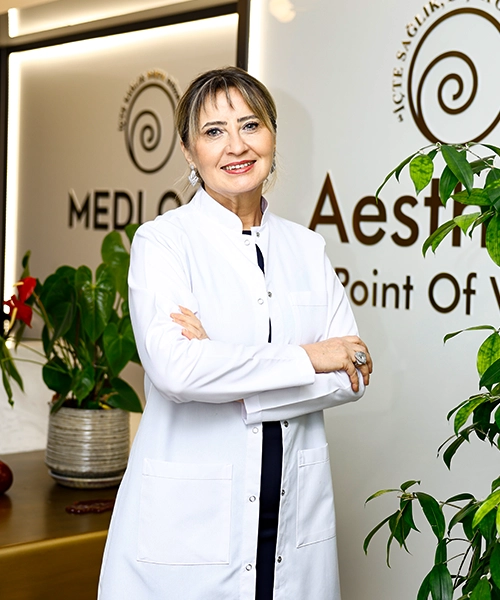
Dr. Handan Yavuz
MAKE AN APPOINTMENT