

Eyebrow Transplant Graft Selection — The Secret to a Natural-Looking Eyebrow Transplant: Choosing the Right Grafts
Eyebrow transplantation is not simply a basic hair transfer procedure that merely fills in gaps. Located right in the center of the face, this area requires meticulous planning at the microscopic level and an artistic eye. Many people worry that after an eyebrow transplant, they will end up with an unnatural, stiff, “grass-man” look.
The most important step in addressing these concerns and achieving a completely natural look is the **graft selection** process for eyebrow transplantation. The structure and thickness of the hair follicles to be harvested from the donor area, and follicle The number of hairs used directly determines the final natural look of the eyebrow. Just as the angle of the selected hairs is important, so too is how well their thickness matches that of the existing eyebrow hairs.
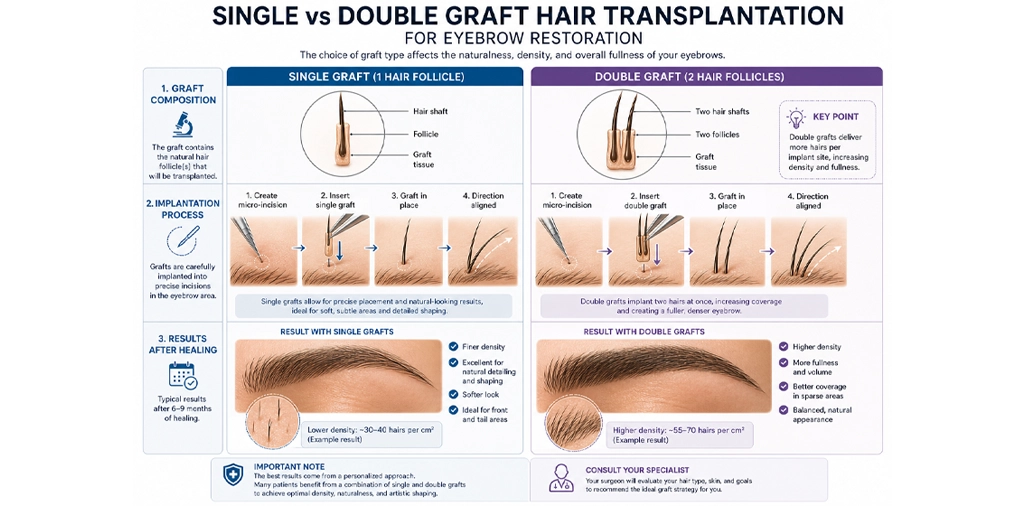
According to Dr. Handan Yavuz’s clinical philosophy, successful eyebrow restoration requires much greater precision than hair transplantation. Since the goal in hair transplant procedures is to achieve maximum density, grafts containing 2, 3, or even 4 hair follicles are preferred. However, using such multi-follicle grafts in the eyebrow area results in a serious aesthetic flaw.
A natural eyebrow is, without exception, composed of individual hairs. For this reason, the grafts taken from the nape of the neck or behind the ears must be examined under a microscope and processed into units containing single hairs. Otherwise, thick hair strands growing side by side will completely ruin the soft texture of the eyebrow.
Patients who wish to undergo eyebrow transplantation should, prior to the procedure, Number of grafts in eyebrow transplantation In addition to planning the procedure, they must also know how to select and separate these grafts. Grafts that are not selected properly may grow at sharp angles in the area where they are implanted or may have a thickness that does not match that of the existing eyebrow hairs.
In cases of partial hair loss, however, this is done solely to cover a specific area Regional eyebrow transplantation These microscopic graft selection rules apply even during these procedures. Each step must be taken in accordance with scientific criteria that preserve the natural hair growth cycle. Incorrect graft selection can disrupt the natural anatomical structure of the eyebrow, making aesthetic corrections more difficult.
A Physiological Comparison of Single and Multiple Grafts
Hair follicles (grafts) at the back of the head or behind the ears naturally vary in structure. The table below details the characteristics of these graft types and their applications in eyebrow transplantation:
| Graft Type | Number of Hairs (Follicles) | Degree of Naturalness | Suitability in the Kaş Region | Intended Clinical Use |
|---|---|---|---|---|
| Single Graft (Single) | 1 Piece | Çok Yüksek (%100) | This is required for all areas of Kaş. | To define the natural eyebrow contours, create a curve, and ensure smooth transitions. |
| Double Graft (Doublet) | 2 Pieces | Low (Must be set to "Single") | If planted directly, it creates an artificial look. | It is separated under a microscope and transformed into two separate single grafts. |
| Triple and Multiple Grafts | 3 or more | Very Low (Unusable) | Its direct use in eyebrow transplantation is strictly prohibited. | It is separated into individual grafts or saved to increase density during hair transplantation. |
As can be seen from the table, the direct use of double or triple grafts in eyebrow transplantation completely compromises the natural appearance. The use of single grafts is a medical necessity to ensure that the transplanted hairs grow individually and that the natural direction and angles of the eyebrows can be replicated. This separation stage directly affects both the comfort of the procedure and the final aesthetic outcome.
How Does the Microscopic Graft Separation Process Work?
Donör alandan (genellikle ense veya kulak arkası) alınan kıl köklerinin tamamı tekli değildir. Alınan greftlerin yaklaşık %60-70’i ikili veya üçlü saç köklerinden oluşur. Bu nedenle operasyon esnasında şu adımlar uygulanır:
- Donor Recruitment: Hair follicles are carefully extracted from the donor area using micro-punch instruments. Instead of being implanted immediately, these extracted units are stored in special petri dishes.
- Microscopic Dissection: Our experienced laboratory technicians examine these double or triple roots under high-resolution microscopes. Using micro-scalpels, they separate these multiple roots one by one without damaging the structure of the hair follicles or the bulb (bulbus) that nourishes them.
- Single-Graft Harvesting: Thanks to this precise dissection procedure, 400 undamaged single grafts are obtained from the 200 paired grafts harvested from the donor site. This procedure is performed in cold solutions that preserve the viability of the hair follicles.
Even the slightest tremor of the hand or moment of inattention during dissection can cause damage to the stem cells in the bulb of the follicle. For this reason, the experience of the clinician and the laboratory team in the field of microsurgery is of vital importance. Keeping the time the follicles spend outside the body to a minimum is another key to success.
During dissection, special refrigerated storage solutions (such as HypoThermosol or Ringer’s lactate) containing biotechnologically produced ATP and essential minerals are used to prevent the follicles from dehydrating. This maximizes the survival time of the hair follicles in the external environment.
Where Are the Most Suitable Hair Follicles for Eyebrow Transplantation Selected From?
Eyebrow hairs are among the finest and softest types of hair on our bodies. Our scalp hair, on the other hand, is generally much thicker and coarser. For this reason, when selecting a donor area, the areas best suited to the caliber of the eyebrow hairs are targeted:
1. Behind-the-Ear Area (Temporal Line): The hair strands in this area are much finer, softer, and more downy than the hair at the back of the head. The follicles that most closely resemble the thickness of natural eyebrow hair are obtained from this area. This area is a top priority, especially for female patients.
2. Lower Boundary of the Nape (Occipital Neck Line): The hair located at the very bottom of the nape, where the neck meets the back of the head, is also fine. When hair is harvested from this area, the hair follicles are more likely to be single and blend well with the curved shape of the eyebrow.
Body hair (such as hair from the arms or legs) can also theoretically be used in eyebrow transplants; however, the survival rates of these hairs are much lower than those of scalp hair follicles, and their growth patterns are irregular. For this reason, scientifically, the most successful results are achieved using fine hair follicles harvested from behind the ears and the lower nape of the neck. Hair from behind the ears is ideal for mimicking the natural, soft transitions of the eyebrows. Due to their genetic makeup, these hairs also grow slightly slower than hair from the neck area, which makes post-operative care much easier for the patient.
The Critical Advantage of the Long FUE Method in Graft Selection
The traditional method Classic FUE eyebrow transplant In this technique, the donor area is completely shaved before the procedure. Since the hair is trimmed down to 1 mm, it is nearly impossible to distinguish the hair’s structure, thickness, color, and—most importantly—the direction of its natural wave (curl) with the naked eye during the extraction process. This situation is akin to the surgeon walking in the dark.
In the **Long FUE** technique, which does not require shaving, the hair is left long. This provides the physician with unique advantages in graft selection:
- By examining the hair strands in the donor area in their natural length, the physician can precisely select the finest strands that best match the structure of the eyebrows.
- Alınan kıl uzun olduğu için kaş bölgesine ekilirken kılın doğal içe doğru kıvrılma açısı (doğal kavis yönü) tam olarak görülebilir. Kılın yönü yüzde %100 doğru ayarlanarak yerleştirilir.
- The likelihood of ingrown, standing-up, or stiff hairs is reduced to zero.
- Since the hair is not shaved at the end of the procedure, the gaps in the donor area are completely concealed from the outside.
Postoperative Health and Recovery Process of the Donor Site
After the hair follicles are extracted from the donor area, microscopic wounds form in that area. The healing of these microscopic wounds progresses quite rapidly, depending on the precision of the technology used. We follow a special care protocol for our patients to ensure the donor area recovers quickly. For the first 3 days after the procedure, the donor site should not come into contact with water, and any contact should be avoided.
Starting on the 4th day, the donor area is washed with special lotions and shampoos to keep it clean. With the Shave-Free Long FUE technique, since the scars in the donor area are hidden beneath the existing long hair, the healing process does not interfere with social life. Since the cells in the scalp have a high capacity for regeneration, scabs typically fall off within the first week, and the skin returns to its former smooth texture.
Frequently Asked Questions
If double or triple grafts are implanted directly, an unnatural appearance results in which 2–3 stiff hairs emerge side by side from a single follicle in your eyebrow. These hairs grow in different directions, completely ruining the aesthetic appearance and making it difficult to comb your eyebrows.
This procedure requires a high level of expertise and specialized microscopes. When performed by our team of laboratory specialists, the risk of damage to the hair follicles is negligible. The separation is performed while preserving the bulbus, which is the vital part of the hair follicle.
During the first year, hair follicles grow at their natural rate because they retain their genetic characteristics. During this period, they need to be trimmed with eyebrow scissors once or twice a week. Over time (within 1–2 years), their growth rate slows down and they adapt to the characteristics of the area.
Men’s natural eyebrow hairs are thicker and coarser than women’s. For this reason, while slightly thicker grafts may be selected for our male patients, we take care to select only very fine and soft, downy hairs for our female patients.
Yes. Examining and separating the grafts taken from the donor site one by one under a microscope requires extra time. However, this stage is the most critical step for achieving a natural look and should never be skipped.
Dr. Handan Yavuz
MAKE AN APPOINTMENT