
Classic FUE and Long FUE Differences - Key Differences Between the Two Methods
 Dr. Handan YavuzKas Architect
7 min read
Dr. Handan YavuzKas Architect
7 min read
Contents
- Technical and Aesthetic Comparison: Shaved vs Unshaven Eyebrow Transplant
- Differences in Operation Time and Laboratory Preparation
- Cost-Effectiveness Analysis and Return on Investment
- Graft Quality and Survival Rates from a Scientific Perspective
- Patient-Centered Process and Physician Preference
- Which One Should You Choose? (Decision Table)
- Frequently Asked Questions
When looking for a permanent solution to eyebrow loss, sparseness or deformities, there are two main medical methods: Traditional, in which the donor area is shaved Classic FUE Eyebrow Transplant and the advanced Long FUE method, in which the hair is left at its natural length. Both techniques are basically folicular unit Although based on the principle of extraction, there is a great difference between them in terms of aesthetic results, intraoperative control power and patient comfort after the procedure. Differences between Classic FUE and Long FUE is found. Choosing the right method for your eyebrows, which are at the focal point of the face and directly determine your expression, is vital for your long-term satisfaction.
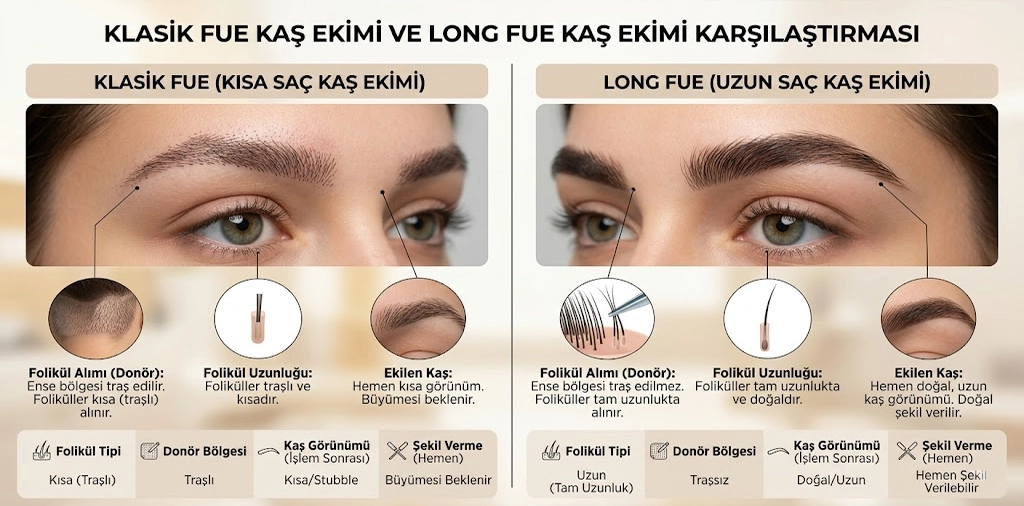
In the classical FUE technique, the hair in the donor area is shaved to a length of 1-2 mm so that the micro-punch tips can approach the root. This short roots When they are planted in the eyebrow, the physician must “guess” their direction and curvature based on his/her experience. Whereas Long FUE eyebrow transplantWhen a long strand of hair (2–4 cm) taken from the back of the head is implanted into the eyebrow along with its root, it is 100 percent clear how the hair will sit on the skin’s surface, what curve it will form, and what angle it will create with the surrounding hairs. At our Istanbul Eyebrow Transplant and Nişantaşı clinics, our team led by Dr. Handan Yavuz analyzes the differences between these two techniques based on our patients’ anatomical needs in order to achieve the most natural results.
The physical characteristics of the hair structure (curl, thickness and color) give important clues to the physician when harvesting from the donor area. When the hair is shaved in the classical FUE method, most of these physical characteristics are lost and the physician tries to find his way in the dark. In the Long FUE method, on the other hand, since the length and wave direction of the hair strand are preserved, the most suitable hair strands are selected and transplanted in the direction of the natural curve of the eyebrow. This is the main biological factor that determines the success of the procedure, especially in patients with wavy or curly hair.
Technical and Aesthetic Comparison: Shaved vs Unshaven Eyebrow Transplant
According to our clinical observations and surgical experience, beyond the superficial differences, the main scientific and practical distinctions of these two methods can be detailed as follows:
- Obligation to Shave and Social Comfort: In the classical method, it is compulsory to cut the hair in the nape area. This creates a serious aesthetic problem, especially for our female patients who do not want to collect their hair or cut it short. In Long FUE, which offers an unshaven eyebrow transplant option, the procedure is completed without cutting a single hair. The donor area completely retains its original appearance, so you don't have to change your hairstyle.
- Angle Verification and the Risk of “Grass Man”: In eyebrow transplantation, the only reason for the artificial, “hedgehog-like” vertical eyebrow appearance is the transplantation performed at the wrong angle. Eyebrow hairs should grow at a horizontal angle parallel to the skin. While adjusting the natural angle (average 10-15 degrees) of short cut 1 mm hairs on the skin millimetrically is based on estimation for the physician; In Long FUE, since the hair is long, the angle is instantly verified and the curve direction is placed with visual reference.
- Psychological Comfort and Immediate Visual Satisfaction: When you look in the mirror immediately after the procedure, with the classic method, you see punctate scars, redness and short hairs like pinheads. With Long FUE, you see your real, long eyebrow hairs. This allows the patient to be happy with his new appearance the moment he gets up from the stretcher and to spend the healing process with a much higher morale. It eliminates the need to be isolated from social life.
Differences in Operation Time and Laboratory Preparation
One of the most obvious practical differences between Classic FUE and Long FUE is the duration of the operation and the laboratory preparation stages of the surgical team. Since the hair is shaved in classical FUE operations, the extraction process progresses quite quickly.
Hair follicles are quickly loosened and collected with the help of standard micro-motors. The operation is usually completed in as little as 2 to 3 hours. Although this may seem like an advantage for patients with time constraints, it may result in compromising aesthetic precision.
In the Long FUE method, the situation is completely different. It requires a high level of precision to select individual follicles from among the long hairs in the nape of the neck and to work under microscopic magnification without mixing the hair strands together. It also takes longer to clean, count and prepare the long grafts for transplantation in the laboratory environment.
Therefore, Long FUE operations usually require a surgical shift ranging from 3 to 5 hours. Dr. Handan Yavuz and her team plan this time with special rest breaks to keep the patient's comfort at the highest level.
Cost-Effectiveness Analysis and Return on Investment
When planning to have an eyebrow restoration, the most common point that our patients get stuck on is the cost differences. It is a fact that the initial cost of Long FUE method is higher than Classic FUE. The main reason for this is the high level of surgical experience required for the operation, long operation times and the special unshaven intake punch technology used. However, this investment should be evaluated with a long-term cost-effectiveness analysis.
In the classical FUE method, patients often need revision transplants if the hairs grow steeply or look aesthetically artificial. A second surgical operation leads to both unnecessary consumption of hair resources in the donor area and a doubling of the total cost. Long FUE, on the other hand, minimizes the need for revision as it guarantees the targeted naturalness and high graft retention rate in the first session. In addition, considering the lifetime fees to be paid for temporary and chemical cosmetic applications such as microblading, Long FUE stands out as a one-time, lifelong permanent and the healthiest investment.
Graft Quality and Survival Rates from a Scientific Perspective
In the medical literature, survival rates of grafts are one of the most important criteria when evaluating eyebrow transplantation methods. In the Long FUE method, the removal of the follicles together with the long hair shaft ensures that the protective anatomical tissue around the follicle (follicular unit sheath) is less damaged.
When a long hair strand is grasped with surgical forceps, it prevents mechanical pressure from being applied to the bulb region, where the stem cells are located. Grafts placed by grasping the hair shaft are not subjected to crush injury. Thanks to this scientific advantage, the graft survival rate in the Long FUE technique is around 95–98 percent, whereas in the Classic FUE technique, this rate ranges from 85 to 90 percent, depending on the surgeon’s experience.
International Society of Hair Restoration Surgery (ISHRS) As noted in the sources, the main difference between follicular unit extraction methods stems from the way grafts are harvested and stored.
Patient-Centered Process and Physician Preference
The success of eyebrow transplantation depends not only on the technique but also on the aesthetic and surgical experience of the physician. Although the classic FUE method is a more common and cost-effective option, the Long FUE technique demands a much higher artistic vision and concentration from the surgeon. It requires intense manual labor to collect the roots from the nape of the neck one by one without damage and to place them in the correct curve with the long hair shaft.
In our Nişantaşı clinic, Dr. Handan Yavuz ensures the quality of the operation by designing a special eyebrow architecture according to the facial structure of each patient. Since the revision of faulty and artificial results is much more difficult and costly, it is critical to choose the right method and specialist physician in the first operation.
Which One Should You Choose? (Decision Table)
Which eyebrow transplant technique is best for your facial architecture? Below you can find a comparison table that will make it easier for you to decide according to your needs and lifestyle:
| Comparison Criteria | Classic FUE Eyebrow Transplant | Long FUE Eyebrow Transplant |
|---|---|---|
| Target Audience | Those looking for more economical solutions and don't mind shaving | Perfectionists, those who want social privacy and have limited time |
| Donor Area Status | A small strip area is shaved at the nape of the neck | No shaving, completely natural length is preserved |
| Operation Duration | Average 2-3 hours (Standard process) | Average 3-5 hours (High craftsmanship and micro details) |
| Return to Social Life | Wait for the scab to fall off (7-10 days) | Same Day (Long strands camouflage scabs and redness) |
| Aesthetic Naturalness Guarantee | Depends on the physician's experience and estimation | Maximum (100% View Angle and Curvature Verification) |
Frequently Asked Questions
Is there a difference between the two methods in terms of retention?
No, in both methods, the transplanted roots are selected from the genetically non-shedding nape area, so the permanence is lifelong. The difference is only in the comfort of the healing process, the quality of the first image after the procedure and the angle sensitivity.
Why is the risk of eyebrow hairs growing upright higher with Classic FUE?
Because when the roots are cut too short and transplanted, the angle of the hair on the skin may deviate slightly during the healing shrinkage of the tissue. Since the hair is not long, this deviation cannot be noticed during the operation. In Long FUE, on the other hand, since the hair is long, directional deviations are detected and corrected instantly.
Which eyebrow transplant method is more suitable for me?
If you do not want to interrupt your social life, are afraid of cutting your hair and want to get a natural eyebrow appearance instantly after the operation, Long FUE is the most suitable method for you. However, if you have a budget priority and can cover the short-term shaved area with your hair, classic FUE can also be preferred.
How is the shock shedding phase experienced after Long FUE?
In both methods, some of the transplanted hairs fall out within the first 1 month (shock shedding). However, since the root sheaths of the transplanted hairs are better protected in Long FUE, the shedding rate may be less and the new hairs that will grow in its place will start to grow faster and stronger.
Are the local anesthesia techniques used different between the two methods?
No, in both operations, needle-free anesthesia devices and local anesthesia are applied to both the donor area and the eyebrow area to be transplanted in order to ensure patient comfort. No pain or soreness is felt during the procedure.
How long does it take for the hair in the donor area to grow after a classic FUE operation?
The hair in the shaved small donor strip grows at a normal hair growth rate (1-1.5 cm per month on average). Within 2-3 weeks after the operation, the shaved area reaches a size that can be completely hidden by the surrounding long hair.
How many grafts can be taken from the back of the head in one go with Long FUE?
In the unshaven Long FUE technique, it is aimed to harvest an average of 400 to 600 grafts (hair follicles) in a single session in order not to disrupt the integrity of the donor area and not to damage the hair strands. This number is more than enough to achieve a perfect eyebrow design and density.