
FUT vs. Long FUE - One Past, One Future: FUT vs. Long FUE
 Dr. Handan YavuzKas Architect
7 min read
Dr. Handan YavuzKas Architect
7 min read
Contents
Many surgical and microscopic methods have been tried throughout the history of aesthetic medicine to combat eyebrow loss, genetic deficiencies or cosmetic deformations. When we compare the methods applied at the beginning of this process, which involved great surgical risks, with today's modern gold standards, we see a tremendous technological leap. In order for our patients who are considering eyebrow restoration to make a decision that will be both safe and satisfied for a lifetime, we have prepared a detailed and detailed report based on scientific data. FUT vs Long FUE is mandatory.
As Istanbul Eyebrow Transplantation, our team led by Dr. Handan Yavuz in our Nişantaşı clinic always prioritizes the methods that create the least trauma and offer the most natural results while planning the treatment of our patients. Old generation FUT Eyebrow Transplant, is an invasive open surgical operation that involves cutting and removing the scalp from the nape of the neck with a scalpel and then closing the wound with sutures. New generation Long FUE eyebrow transplant is a highly advanced and comfortable technology that removes the follicles one by one with their original hair strands without cutting the skin, suturing or shaving the hair.
Tissue healing times of both methods differ greatly at the cellular level. In FUT surgery, the body has to produce a large amount of collagen fibers and granulation tissue to join the two skin edges separated by the scalpel. This leaves a large scar area on the neck. In the Long FUE method, on the other hand, the elastic fibers around the micro-holes immediately shrink the hole closed and heal quickly without straining the body's repair mechanisms.
Why Long FUE is Unquestionably Superior?
The main reasons why these two methods are “incomparable” in terms of modern medical standards are the degree of surgical trauma to the patient, the speed of recovery and the ability for instant aesthetic verifiability. Let's examine why Long FUE, considered the best eyebrow transplant technology, is by far ahead in this competition between old and new eyebrow transplant techniques:
- Precise Visualization and Angle Verification: In the FUT technique, since the scalp is broken, the roots obtained are very short, 1-2 mm in length. This shortness prevents the physician from seeing the natural curve direction of the hair with the naked eye or under a microscope. The physician has to guess the direction while transplanting. In Long FUE, on the other hand, since the hair length (average 2-4 cm) is preserved, the physician has the chance to see the natural curve and angle of the hair in seconds and place it perfectly.
- Non-Surgical Skin Comfort and Safe Eyebrow Transplantation: In the Long FUE method, which does not use scalpels and stitches, no incision line is created in the nape of the neck. In this way, the risk of headaches due to suture tension, sleep difficulties or the risk of a horizontal scar on the nape of the neck that will remain for a lifetime without hair growth is completely eliminated. For patients looking for a safe eyebrow transplant, Long FUE will be the right choice of eyebrow transplant method.
- Zero Day Social Isolation: Since the donor area is not shaved and the transplanted roots are naturally covered with long hair strands, you can return to your work life and social activities with self-confidence the day after the operation without wearing a hat or camouflage.
- Rapid Tissue Healing: Since there is no incision line, the micro channels in the donor area are completely closed within an average of 48 hours and the risk of wound infection approaches zero.
Comparison of Extracellular Matrix and Graft Nutrition Mechanisms
The most critical physiological factor determining the survival of the transplanted follicles in tissue transfer surgeries is the integrity of the extracellular matrix of the hair follicle. In the FUT technique, the skin of the nape of the neck is cut with a scalpel and removed in an elliptical shape, then sliced with laboratory scalpels under a microscope. This rough cutting process removes the microvessels, nerve endings and micro vessels around the follicle that nourish the root. Collagen (dermal sheath) is largely destroyed. Separated from its tissue and almost naked, these roots find it much more difficult to feed in their new location.
In the Long FUE method, each hair follicle is extracted along with its natural protective tissue sheath by creating a circular incision using micro-punch tools. The extracellular matrix structure and the adipose (fat) tissue surrounding the follicle remain completely intact. As a result, the process of neovascularization (new blood vessel formation) occurs much more rapidly in the eyebrow area where they are implanted. From the moment they are implanted, the follicles begin to receive nourishment via diffusion from the surrounding tissues, and their survival rates reach excellent levels of 98 percent.
International Society of Hair Restoration Surgery (ISHRS) As emphasized in the sources, the method of harvesting from the donor site is the most defining distinction between the two techniques.
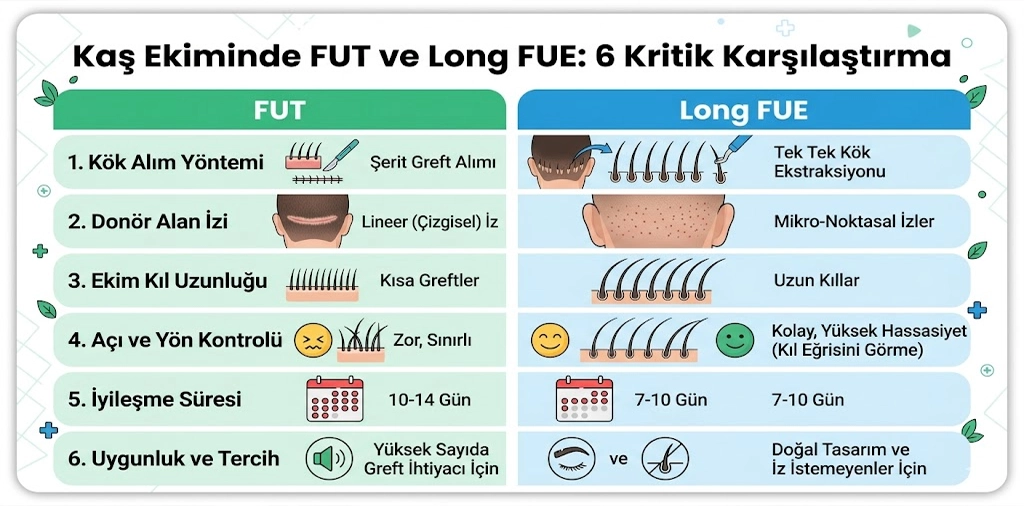
Postoperative Psychological Trauma and Quality of Life Assessment
The success of aesthetic operations is measured not only by physical results but also by the psychological comfort the patient experiences after the operation. Large open surgical procedures such as the FUT method can cause anxiety and stress in the patient after a serious operation. The large suture line in the neck, the feeling of tension for weeks and the fear of burst stitches negatively affect the patient's quality of daily life. Insomnia, headaches and the need to stay away from social life for a long time wear the patient down psychologically.
In the Long FUE technique, the patient's psychological adaptation process is extremely comfortable as the surgical trauma is minimized. As soon as the operation is over, the patient picks up a mirror and sees the long and full eyebrows he/she immediately imagines instead of a red and stitched wound. This instant visual satisfaction (instant gratification) maximizes the motivation to recover after the operation. Our patients who do not feel the need to escape from social environments can continue their daily routines the day after the operation, feeling completely normal and healthy.
Physiological Recovery and Complication Management
The postoperative physiological processes of FUT and Long FUE methods directly affect the quality of patient recovery. In the FUT technique, complications such as dehiscence of the sutures (dehissans), risk of infection, permanent enlargement of the wound site and months of numbness due to the cutting of sensory nerves are frequently reported. With the Long FUE method, the risk of infection is close to zero and the possibility of nerve damage is completely eliminated, as only millimetric openings are created. The healing process is completed in 3-5 days with only mild redness and crusting.
Scientific Comparison Table
So that you can clearly see the structural differences between FUT and Long FUE, we compared the two methods according to basic aesthetic and surgical criteria:
| Comparison Criteria | FUT Method (Old Generation Surgery) | Long FUE Method (Modern Unshaven) |
|---|---|---|
| Donor Area Root Procurement | Removed by cutting a strip of skin with a scalpel | Roots are collected one by one with micro punches |
| Suture and Scarring | Mandatory, leaves a thick horizontal mark on the back of the neck | Seamless, microscopic spots close without leaving a trace |
| Time to See Eyebrow Form | Wait 6-8 months for the shedding and growth phase | Instant plump appearance on the operation stretcher |
| Hair Angle and Direction Accuracy | Estimated placement due to short roots, risk is high | Since the hair is long, this is a 100% clear visual reference |
| Donor Zone Insensitivity | Long-term or permanent numbness due to the incision | There is absolutely no risk of numbness or sensory loss |
However, the Long FUE technique is considered a middle generation technology Classic FUE Eyebrow Transplant It is also far superior to the classic FUE method because in classical FUE, the donor area needs to be shaved with a window, while in Long FUE, not a single hair is cut, ensuring complete privacy and comfort.
Related guide: Common Mistakes in the FUT Technique.
Frequently Asked Questions
Is the Long FUE procedure more expensive than the FUT method?
Yes, the Long FUE technique is more costly than older surgical methods because it requires a much higher level of manual labor, advanced micro-surgical equipment, long working hours and high-level experience of the surgeon. However, the comfort and naturalness it offers is well worth the investment.
Why do the two methods have different lead times?
Because in the FUT method, the follicles are cut and shortened and it takes months for them to grow back. In Long FUE, on the other hand, since the hair strands are transplanted by preserving their original length, you will instantly see your designed full eyebrows immediately after the operation.
Does the FUT method give a bushier or denser result in the eyebrows?
Absolutely not. In both methods, as many roots are placed in the area to be transplanted as the number of grafts needed. The factor that determines the density and lushness of the eyebrow is not the name of the technique, but the frequency planning and artistic design of the transplant doctor.
Does hair tattooing (simulation) on the FUT suture scar completely cover the scar?
Although hair simulation visually lightens the scar, it does not offer a permanent and three-dimensional solution. The most natural camouflage solution is to transplant individual healthy hair follicles on the scar with the FUE method.
Can an area other than the nape be used as a donor area in eyebrow transplantation?
Since the closest, thin and single roots to the eyebrow structure are found in the nape of the neck (areas near the back of the ear), the primary preference is always the nape. Body hairs (such as arm or leg) are not preferred for eyebrow transplantation because they have very low adhesion rates and directional control is difficult.
What should be done if infection develops in the sutures after FUT operation?
If signs of infection such as redness, discharge, throbbing pain or fever appear at the suture line, you should consult your doctor immediately. Usually the infection can be controlled with early antibiotic treatment and local dressings.
Is itching of the scar on the neck normal after FUT technique?
Yes, itching is normal during wound healing and tissue shrinkage. However, if itching persists for months and the scar continues to swell, this may be a sign of hypertrophic scarring or keloid development and requires dermatologic evaluation.
Yes, itching is normal during wound healing and tissue shrinkage. However, if itching persists for months and the scar continues to swell, this may be a sign of hypertrophic scarring or keloid development and requires dermatologic evaluation.