
What is Classic FUE Eyebrow Transplantation and What Are Its Stages?
 Dr. Handan YavuzKas Architect
10 min read
Dr. Handan YavuzKas Architect
10 min read
Contents
- Pre-Operational Preparation and Planning Criteria
- Punch Diameter and Micromotor Technology in FUE Method
- Why the classical method is no longer enough
- FUE Eyebrow Healing Process: Step-by-Step Physiological Stages
- Classic FUE vs Modern Long FUE
- Patient Candidacy Criteria for Classic FUE Eyebrow Transplant
- The Importance of Postoperative Care in the Classical Method
- What to Consider When Transitioning from Classic FUE to Long FUE?
- Frequently Asked Questions After Classic FUE
- Factors Affecting Graft Survival in Classical FUE
- Classic FUE and Patient Expectation Management
- Frequently Asked Questions
The FUE (Follicular Unit Extraction) method, which has revolutionized the old techniques of hair restoration with stitches and scars, has been successfully adapted to eyebrow transplantation over time. Classic FUE Eyebrow Transplant, It is the process of collecting healthy and fine-structured hair follicles from the nape of the neck, which is selected as the donor area, one by one with the help of a micromotor or manual punch and transplanting them into micro channels opened in the eyebrow area. However, in the adaptation of this traditional method from hair transplantation to eyebrow architecture, there are some technical limits for physicians and some stages that make the post-operative process difficult for patients.
In our Istanbul Eyebrow Transplant clinic, our expert staff led by Dr. Handan Yavuz informs our patients about the stages of the FUE method to the finest detail. A standard classical FUE application is carried out with the following stages:
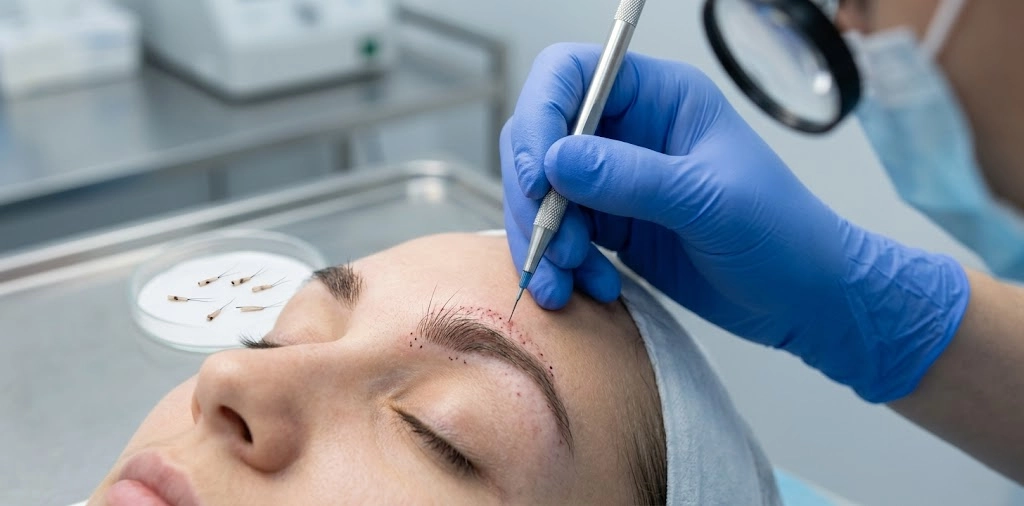
- Donor Site Preparation and Shaving: Some of the hair on the nape of the neck, which is determined as the donor area, is shaved to a length of 1-2 mm so that the micro punch tips can approach the hair follicle at the right angle. The necessity of shaving in eyebrow transplantation is the biggest aesthetic disadvantage of the procedure, especially for our female patients who do not wear their hair short. The grafts taken from this area are made ready for sterile environment.
- Local anesthesia and graft harvesting: Local anesthesia is applied to the donor area. Millimeter micro punches are used to extract the follicles. Hair follicles are collected individually in single or double follicular units (grafts) without any damage and kept in protective solutions. The quality of local anesthesia determines the comfort during extraction.
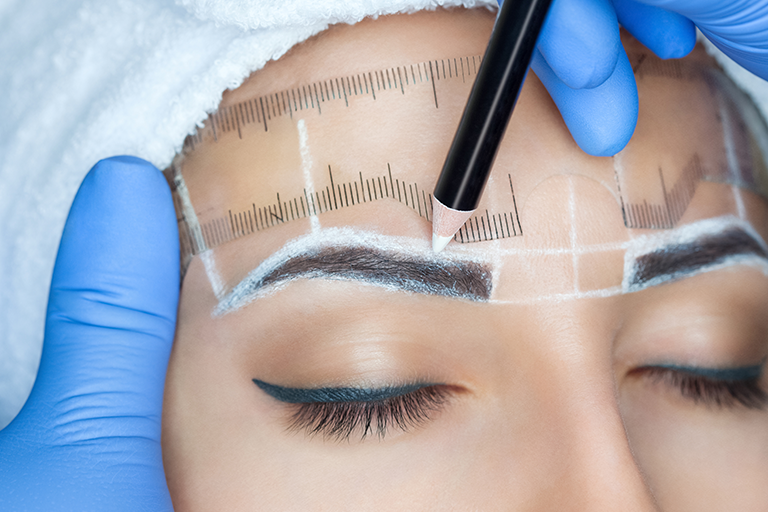
- Receiving Zone Design and Channelization: Local anesthesia is applied to the eyebrow area to be transplanted. The physician opens micro channels that determine the natural eyebrow curve and directions by adhering to the golden ratio measurements.
- Placement of Roots Collected short hair roots, are placed one by one into the opened micro canals with great care. It is critical that short roots are placed with tweezers without damaging them.
Pre-Operational Preparation and Planning Criteria
As with any surgical intervention, classic FUE eyebrow transplantation requires a meticulous preparation phase before the operation. Patients who apply to our Nişantaşı clinic first undergo routine blood tests and infectious disease screenings to confirm the presence of a systemic disorder. Our patients are asked to stop consuming blood thinners (aspirin, etc.), herbal teas and green tea at least 7 to 10 days before the procedure. This minimizes bleeding during the operation and improves the physician's field of vision and canal quality.
In the planning phase, Dr. Handan Yavuz measures the patient's eye fountain, temple and nose alignments millimetrically with the help of digital calipers. This analysis enables the determination of the most suitable eyebrow thickness and arch angle for the person's gender, age group and bone structure. After the design is drawn and the patient's written consent is obtained, the operation room is entered. This precision in the preparation phase is a parameter that directly affects the success of the aesthetic result.
Punch Diameter and Micromotor Technology in FUE Method
The characteristics of the equipment used during root harvesting play a direct role in the future health of the donor site and the success of the attachment of the transplanted grafts. The diameter of the micro motor tips (punch) used in the classical FUE method usually varies between 0.6 mm and 0.8 mm. Since the hair follicles in eyebrow transplantation are desired to be as thin as possible, titanium punches with the narrowest diameter of 0.6 mm are always preferred in our clinic. The small diameter of the punch allows the micro scar in the area where the root is removed to close much faster and does not leave permanent baldness spots in the donor area.
The speed of the micromotor is also a critical setting for the safety of the procedure. Micromotors operating at high speeds can cause heat transfer (thermal damage) in the tissue surrounding the hair follicle, leading to the death of stem cells. Our surgical team, led by Dr. Handan Yavuz, protects the follicles from heat damage by keeping the micromotor speed at the lowest possible level or by using a completely manual punch technique. This scientific approach ensures that over 95 percent of the transplanted follicles survive in the eyebrow region.
Why the classical method is no longer enough
While FUE is a great improvement compared to the FUT (stitched) method, classic FUE has some serious limitations when it comes to delicate facial aesthetics and eyebrow architecture. The answer to the question of how eyebrow transplantation is not only to move the roots, but also to ensure that the hairs grow at a natural angle.
The biggest technical weakness of classical FUE is that it cannot guarantee the “hair curve direction” during the operation. Since the hair follicles are cut in very short sizes such as 1-2 mm, it is not possible for the physician to see the natural curve direction of the hair with the naked eye or under a magnifying glass. This creates aesthetic risks such as the transplanted eyebrows growing steeply or curling outward when they grow.
However, windowed shaving in the nape of the neck makes the patient noticeable from the outside after the procedure. For our patients who want to return to their social life quickly or prefer to keep the operation private, classical FUE can be restrictive as it requires a 10-14 day hiding and scabbing process. These restrictions directly affect the comfort and overall satisfaction of our patients after the operation. In order to eliminate these disadvantages, more modern technologies such as unshaven Long FUE are now preferred.
FUE Eyebrow Healing Process: Step-by-Step Physiological Stages
After the operation performed with the classical method, the FUE eyebrow healing process requires meticulous follow-up. The first 3 days after the procedure is the most sensitive period. Micro leaks from the transplanted channels cause crusting.
These crusts act as a natural glue that allows the roots to hold in place. For the first 10 days, a gentle washing procedure is applied with special lotions and shampoos recommended in our clinic. At the end of the 10th day, the crusts fall off completely and the skin under the eyebrows regains its pink, healthy appearance.
From the 2nd week of recovery, the “shock shedding” phase begins, in which the transplanted hairs fall out. In this phase, it is only the body of the hair that falls out; the hair follicles remain viable under the skin and thefollicle goes into a resting phase. After this quiet period, which lasts about 3 months, the follicles start to produce new eyebrow hairs.
By the 6th month, approximately 60–70 percent of the eyebrow grafts have taken, and by the 12th month, the eyebrow restoration process is fully and successfully completed. During the healing period, factors such as nutrition, smoking, and protection from direct sunlight play a critical role in graft viability. Supportive treatments such as PRP and mesotherapy also significantly accelerate this healing phase.
The Importance of Right Angle and Channel Depth
The two most important factors that determine naturalness in the classical FUE method are the angle and depth of the transplantation channels. The eyebrow skin has a much thinner structure than the scalp and there is bone tissue just below it. For this reason, opening the channels too superficially prevents the roots from holding on, while opening too deep causes permanent scars and damage to the hair follicles.
The channels opened by the physician must form an acute angle of 10-15 degrees with the skin surface. Adjusting this precise angle is only possible with a high level of manual dexterity and micro-surgery experience. Dr. Handan Yavuz guarantees the success of the operation by opening each channel in the appropriate directions for the facial structure under millimeter magnifiers.
Classic FUE vs Modern Long FUE
In order to overcome the technical limitations of the standard FUE method and achieve more natural results, we have developed Long FUE eyebrow transplant You can examine the main differences between the technique and classical FUE in the table below:
| Comparison Criteria | Classic FUE Method | Modern Long FUE Method |
|---|---|---|
| Shaving Requirement | A specific area is shaved in the donor area | Unshaven (Hair is all original length) |
| Bristle Direction and Angle Control | Predictive, high margin of error | 100% Control (The direction is clear because the hair is long) |
| Post Process View | Short spiky hairs in the shaved donor area and transplantation site | Instant Natural Look (Long hairs cover the shells) |
| Return to Social Life | Wait 10 days for the scab to fall off | The Day After (No need for any camouflage) |
| Processing Time and Precision | Takes 2-3 hours on average, standard | Takes 3-5 hours, requires microsurgical precision |
International Society of Hair Restoration Surgery (ISHRS) As noted in the sources, the method of graft harvesting and the length of time the graft remains outside the body are critical factors affecting the take rate.
Patient Candidacy Criteria for Classic FUE Eyebrow Transplant
Not every patient may be equally suitable for every method. When evaluating classical FUE, the hair structure in the donor area, skin health and the patient's social life tempo are considered together.
The classical method can give results in patients who do not mind shaving and can spare a few days for recovery. However, unshaven options are more suitable for those who want their appearance to return to normal quickly.
The candidacy assessment determines which technique fits your lifestyle. The right method is the one that suits you best, not the most advanced one.
The Importance of Postoperative Care in the Classical Method
Recovery after classic FUE requires a little more care due to the shaved donor area and scabbing. Protecting the area from friction in the first days is the most basic rule to prevent graft loss.
Following the washing regime ensures that the bark falls off at the right time. Premature intervention risks roots that have not yet taken root.
We provide a step-by-step program that explains the care process. If this guide is followed, the classical method can also give healthy and natural results.
What to Consider When Transitioning from Classic FUE to Long FUE?
Many patients who have been previously informed about the classic method want to switch when they hear about the unshaven option. When making this decision, we re-evaluate your current eyebrow structure and donor area.
The main difference between the two methods is the time it takes to shave and see the result; the technical background is based on similar principles. The transition is therefore smooth for most patients.
After listening to your expectations, we will determine together which method makes the most sense for you. The decision is always made with your comfort as a priority.
Frequently Asked Questions After Classic FUE
After classic FUE, patients are most curious about when the scabs will fall off and when the eyebrows will become prominent. The scabs that form in the first week fall off in about ten days with proper washing.
The shock shedding phase that follows is a temporary process; the roots remain under the skin and new hairs grow in a few months. Knowing this cycle eliminates unnecessary anxiety from the beginning.
The appearance of the shaved donor area is also a frequently asked question. As the hair grows, the area returns to normal and becomes unnoticeable. We share every stage of the process with you and keep your expectations realistic.
Factors Affecting Graft Survival in Classical FUE
The retention rate of grafts transplanted in the classical method depends on several technical factors. The length of time the roots remain outside the tissue after extraction, the storage conditions and the precision of the canal opening are directly reflected in the result.
Since it works with short-cut roots, the correct estimation of the direction and angle of the hair depends on the experience of the physician. Therefore, in the classical method, the experience of the practitioner plays a decisive role in the quality of the result.
We meticulously manage each stage to maximize graft survival. Nevertheless, the advantage of being able to work with a live view of the hair direction is the main difference that distinguishes modern methods.
Classic FUE and Patient Expectation Management
The most important step for patients considering the classical FUE method is to set realistic expectations. Knowing the strengths and limitations of the method in advance prevents disappointment at the end of the process. Therefore, in the first consultation, we clearly discuss the need for shaving, the healing time and when the result will be evident.
The patient's pace of life is also decisive in this decision. While the classical method is suitable for a person who can be away from social life for a few days, different options come to the fore in cases that require a quick return.
Managing expectation correctly is as important as the technique itself. Transparent information allows the patient to start the process with confidence.
After listening to your priorities, we will decide together which method is right for you. The right decision is the result of a joint assessment.
The classic FUE method can provide healthy results when combined with the right patient selection and a careful care process. However, it may not be the most suitable option for every patient in terms of shaving requirements and healing comfort. Together with a detailed assessment, we will determine which method fits your lifestyle and expectations. The important thing is not the most advanced method, but the one that is right for you.
Frequently Asked Questions
Are there any scars after classic FUE eyebrow transplantation?
No, there are no stitches or scalpel marks on the back of the neck as the harvesting is done with micro-punches. When the healing process is complete, the donor area returns to its former state. When the hair grows in the nape of the neck, the harvested points become completely invisible.
Do I have to shave all my hair for Classic FUE?
No. Usually a small strip of hair is shaved at the nape of the neck, which is covered when the hair on top is left free. However, the hair in that area is still cut and this can be noticeable, albeit temporarily, for those who want to wear their hair up or in a ponytail.
How long does it take for the eyebrows to be finalized?
Since the short roots transplanted in the classical FUE method will shed and regrow, it takes about 8 to 12 months for the eyebrows to reach their ideal density, thickness and length. Patience is required for the final result.
How is the care of transplanted eyebrows after classic FUE?
For the first 10 days, the eyebrows should not be touched and should be protected from friction. After the crusts fall off, normal life can be resumed. Since the transplanted hairs will grow fast in the eyebrow area, they should be regularly trimmed with scissors in the first months.
Can a natural eyebrow appearance be achieved with the classic FUE method?
Yes, in the hands of an experienced surgeon, extremely successful and natural results can be obtained with the classical FUE method. However, it is critical for the physician to predict the direction of hair growth very well and to open the channels at as narrow an angle as possible.
How long after the classic FUE procedure can I do sports?
You should avoid heavy sports, sweaty activities and weight lifting for the first 2 weeks after the procedure. Sweating can negatively affect the attachment of hair follicles. You can start light walking from the 5th day.
How often should eyebrows transplanted with the classical FUE method be trimmed?
Hair follicles taken from the nape of the neck maintain their genetic growth rate in the eyebrow area. For this reason, for the first 1-2 years, you usually need to shorten the eyebrow length with fine-tipped scissors 1 or 2 times a week. Over time, the hairs begin to grow more slowly by keeping up with the metabolism of the eyebrow area.