

Eyebrow Transplantation for Injured Eyebrows — Eyebrow Loss Due to Scarring
Permanent damage to the eyebrow area can result from household accidents, falls, traffic accidents, surgical stitches, or burns sustained during childhood. Such physical trauma causes the permanent loss of hair follicles beneath the skin and the development of “scar tissue” in that area. Unlike normal skin tissue, scar tissue does not contain hair follicles, and this creates gaps in the center or at the edges of the eyebrow, disrupting the overall symmetry of the face.
Although many people try to cover these marks with cosmetic pencils or permanent makeup, due to the nature of scar tissue, these pigments cannot adhere to the skin and end up looking unnatural. At this stage, Eyebrow Transplant for Injured Eyebrows These treatments are the most effective way to completely conceal a scar and restore a natural, vibrant hair texture to that area.
At our clinic, led by Dr. Handan Yavuz, we apply specialized hair transplant protocols for sensitive areas with scars and suture marks. Hair transplants performed on scar tissue require a much higher level of technical precision and medical expertise than those performed on normal skin tissue. In this guide, we will discuss in detail the scientific aspects of eyebrow transplantation on scar tissue, the characteristics of scar tissue, and the success of the Long FUE technique in these challenging cases.
The Biological Structure and Challenges of Scar Tissue
Before performing eyebrow transplantation on an injured area, it is essential to thoroughly analyze the biological characteristics of the scar tissue. Areas with scars have the following differences compared to normal skin:
- Poor Blood Circulation: The density of capillaries in scar tissue is significantly lower than in normal skin. Since blood circulation is vital for the grafted follicles to take root, the nourishing capacity of the scar tissue must be carefully assessed.
- Firm and Fibrous Structure (Collagen Density): In healing wound sites, flexible elastin fibers are replaced by rigid collagen fibers. This rigid structure makes the procedures of canal preparation and root placement mechanically more difficult.
- Thinning or Thickening of the Skin: Depending on the type of wound (atrophic or hypertrophic), the skin may be thinner or thicker than normal. This requires the depth at which the grafts are placed to be adjusted to the nearest millimeter.
Scar tissues are classified into different types. Atrophic scars, where the skin is sunken, are generally areas where grafting can be performed successfully when the depth of the incision is properly adjusted. However, hypertrophic scars—which are raised and firm—or tissues exhibiting keloid-like excessive scar growth require special evaluation.
In patients with a history of keloids, the procedure may be considered contraindicated because it could trigger the formation of a new keloid. For this reason, the type of tissue must be determined during the trichological examination.
How Is Eyebrow Transplantation Performed on a Scar?
At our clinic, the following scientific steps are followed when performing hair transplantation on scar tissue:
1. Tissue Blood Flow Analysis
To ensure the survival of the grafted hair follicles, blood flow to the recipient site is monitored. In very hard scar tissue where blood flow has almost completely stopped, tissue nutrition is supported through the application of local growth factors (autologous serum/PRP) before or during the transplant to increase the graft take rate.
2. Micro-Channel Design (Microtunneling Technique with Sapphire Tips)
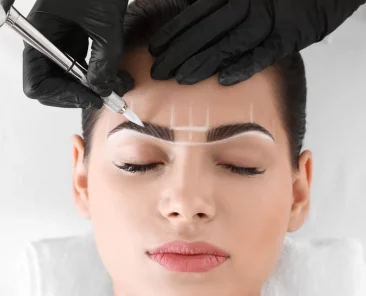
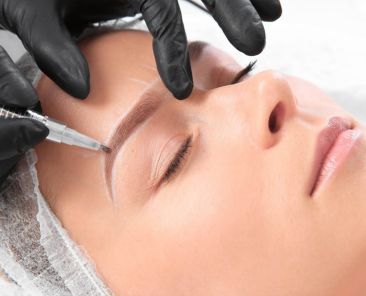
Microchannels are created using extremely fine sapphire tips without damaging the tough structure of the scar tissue. When creating channels in scarred areas, we use a method we call “microtunneling.” In this method, the hard, fibrous layer of scar tissue is penetrated using a sapphire blade to reach the healthy subcutaneous (under the skin) layer, where capillaries and fatty tissue are more abundant. This allows the transplanted follicle to be nourished by the healthy blood vessels beneath the scar.
3. Angle and Direction of Occlusion
To completely conceal the scar, the hair is implanted at extremely flat angles—10 to 15 degrees—against the skin. When the hair is directed to form a bridge over the scar, the scar tissue is completely camouflaged beneath it. During this process, Long FUE Using this technique allows the hair to be positioned to best conceal the scar by taking into account its natural curl. Thanks to the long hair shafts, the angle at which the hairs cover the scar can be controlled down to the millimeter.
PRP and Cellular Growth Factor Therapy in Scar Tissue Grafts
Poor blood circulation in scar tissue is the greatest risk factor that can reduce the survival rate of transplanted hair follicles. To eliminate this risk, we administer local PRP (Platelet-Rich Plasma) injections 2 to 4 weeks prior to surgery in patients scheduled for eyebrow transplantation in scarred areas. PRP injections stimulate the formation of new capillaries (angiogenesis) by activating growth factors within the scar tissue and softening Collagen softens the bonds.
During the PRP preparation process, approximately 10–20 cc of blood drawn from the patient is placed in special sterile tubes and processed in a high-speed centrifuge. After centrifugation, the red blood cells (erythrocytes) settle at the bottom, while the plasma—rich in platelets and growth factors—separates and rises to the top. This valuable plasma is then injected into the scarred area at intervals of 0.5 cm using insulin syringes.
These injections stimulate fibroblasts in the scar tissue, thereby balancing the synthesis of new collagen and elastic fibers. Balancing fibroblast activity in this way also increases the elasticity of the stiff and contracted tissue in the scar area and directly helps the skin become smoother after surgery.
Ayrıca operasyon günü de ekim işlemi bittikten hemen sonra köklerin tutunmasını desteklemek için alana büyüme faktörü kokteylleri uygulanır. Klinik çalışmalar, ön hazırlık olarak yapılan PRP tedavisinin skar dokusundaki greft tutunma başarısını yaklaşık %20 ila %30 oranında artırdığını ve normal cilt dokusundaki başarı oranlarına (%90 ve üzeri) yaklaştırdığını göstermektedir. Bu kombine yaklaşım, zorlu skar vakalarında bile doğal ve kalıcı sonuçlar almamızı sağlar.
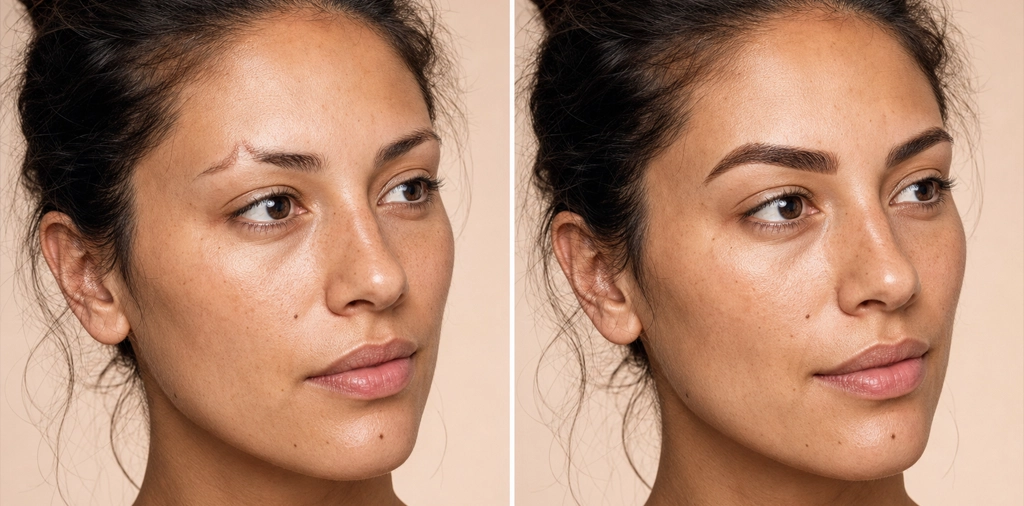
Comparison of Grafting on Normal Skin and Wound Tissue
The table below shows the technical and biological differences between hair transplants performed on normal eyebrow skin and on injured (scarred) eyebrow skin:
| Parameter | Standard Eyebrow Transplant | Eyebrow Transplant for Injured Eyebrows (Over a Scar) |
|---|---|---|
| Blood Circulation and Nutrition | Normal level (Rich in capillaries) | Limited (Low capillary density) |
| Root Survival Rate | %95 – %98 | %80 – %90 (Destekleyici tedaviler gerekebilir) |
| Channel Excavation Depth | Standard depth (depending on skin type) | Specific depth (reaching the boundary of healthy tissue) |
| Number of Sessions Required | One session is usually sufficient | A second session may be necessary for very large scar areas |
| Recovery Time | 7–10 Days | 10–14 Days (Scar tissue heals more slowly) |
As indicated in the table, procedures on damaged tissue require extra care and expertise. Achieving high success rates despite limited blood circulation is directly related to the correct channel technique and the angle at which the hair follicles are implanted. If you are experiencing general eyebrow thinning and are looking for permanent solutions, first of all The Definitive Solution for Thicker Eyebrows You can review our guide. Also, to compare scar treatments with traditional hair transplant methods, Classic FUE eyebrow transplant You can check out our page.
The Role of the Long FUE Method in Scar Transplantation
The Long FUE method, which allows for transplanting long hair follicles without shaving, offers significant advantages to the physician in cases involving scar tissue. Because the hair is long, it is possible to see immediately during the procedure how much of the scar is being covered. The direction of the hair is adjusted with millimeter precision based on whether the scar runs horizontally or vertically.
Additionally, since no shaving is required, the patient’s existing eyebrow structure remains intact, and the procedure performed on the scarred area is camouflaged so that it is not noticeable from the outside. To learn more about scar formation and hair transplant criteria following autoimmune-related hair loss, Eyebrow hair loss following alopecia You can read our article.
The Healing Process in Postoperative Scar Tissue
The healing process following eyebrow transplantation on the treated area must be closely monitored. Since scar tissue is more sensitive than normal skin, the antibiotic creams and lotions provided by our clinic must be used regularly to prevent the risk of infection. It is normal to see mild scabbing and redness in the treated wound area during the first few days. The scabs will fall off within 10–12 days.
The shock loss phase also applies in these cases. Starting in the third week, the transplanted hairs will fall out, and starting in the third month, permanent eyebrows will begin to grow from the follicles nourished from beneath the scar tissue. It takes 12 months for the scar to heal completely and for the final, natural appearance to be achieved. During this time, periodic follow-up visits are conducted at our clinic.
**”At Istanbul Eyebrow Transplant, every procedure is customized following a detailed facial analysis. Please contact us for more information about eyebrow transplants for damaged eyebrows.”**
Frequently Asked Questions
Yes, when roots are placed in microchannels created at the edge of the living tissue by penetrating beneath the scar tissue, they take root at a high rate and grow healthily.
You should wait at least 6–9 months after an injury or surgical procedure to allow the scar tissue to fully mature (maturation phase) and for the redness to subside.
Yes, eyebrow transplantation can be successfully performed by analyzing the circulation in that area—including areas with deep burn scars—and, if necessary, increasing blood flow through PRP-assisted treatments.
For small stitches and scars, a single session is usually sufficient. However, in cases of poor circulation and extensive burn areas, two sessions may be scheduled in stages to avoid compromising the blood supply to the hair follicles.
When performed at the correct angle (flat against the skin) and with the appropriate density, the hair follicles cover the scar, making it completely invisible from the outside.
Dr. Handan Yavuz
MAKE AN APPOINTMENT