

Feared Scenario in Eyebrow Transplantation: Hedgehog Appearance and Steep Eyebrows
The biggest concern behind the fact that many people who experience eyebrow loss or want to have fuller eyebrows stay away from eyebrow transplantation is the artificial, steep and uncontrolled growth of the transplanted hairs. In the aesthetic medical literature, it is called “misdirected graft placement” and is popularly known as the hedgehog appearance. eyebrow transplantation in eyebrow transplantation Unfortunately, this problem is one of the most typical consequences of unsuccessful surgical procedures. However, this is not an inevitable result of the eyebrow transplantation procedure itself, but an application defect caused by technical errors and anatomical deficiencies.
In modern eyebrow restorations performed under the guidance of Dr. Handan Yavuz in our clinic, advanced microsurgical techniques and millimetric angle calculations are used to prevent such aesthetic errors. Long FUE One of the biggest advantages of the technique is that the hair follicles are transplanted in their long form without shaving. In this way, the natural slope and growth direction of the hair can be seen with the naked eye during the procedure. In this article, we will discuss the anatomical causes of the problem of steep growth in eyebrow transplantation, how this error can be prevented and which corrective methods can be applied if you have encountered this problem.
Anatomical and Technical Causes of Steep Eyebrow Problem
The anatomy of hair and eyebrows is extremely different from each other. Hair transplantation The grafts are placed on the scalp at obtuse angles, usually 45 to 60 degrees. This vertical or semi-vertical position is considered normal in the nature of hair.
But when it comes to the eyebrow area, the physiology changes completely. Eyebrow hairs grow at extremely narrow angles of 10 to 15 degrees, almost parallel to the skin surface. Failure to give this narrow angle is the main cause of the problem of eyebrows that grow directly perpendicular.
We can list the main factors that cause this problem to occur as follows:
- Technical Errors During Channel Opening: The tools used during the root canal opening phase are thick and held perpendicular to the skin, causing the opened canals to heal at a steep angle.
- The Natural Structure of Hair Roots: Nape hair is used as the donor area for eyebrow transplantation. Hair hairs are thick and light; eyebrow hairs are much thinner and softer. Thick hair follicles transplanted without the correct hair diameter analysis are inherently more prone to standing upright.
- Failure to take into account the curvature of the hair: Each hair has a curve at the micro level. If the direction of this curve (inward curve) is not adjusted parallel to the skin during transplantation, the hair will take a perpendicular direction outward as it grows.
- Shaven Sowing Methods: Traditional Classic FUE eyebrow transplant Since the hairs are cut close to zero in the technique, it is almost impossible to predict the direction of the curve of the root. This increases the risk of steep growth.
How to Avoid Incorrect Brow Angles? Modern Approaches
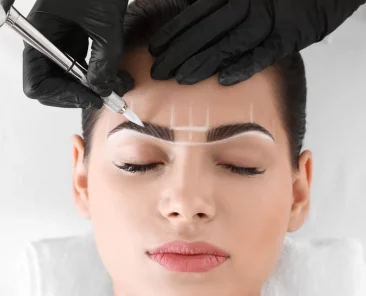
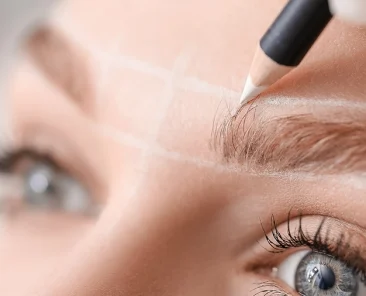
Special techniques and advanced experience must be combined at each stage of the operation to avoid the problem of raised eyebrows. The protocols we apply in our clinic aim to reduce this risk to zero. As a first step, the exit directions varying according to the anatomical regions of the eyebrow are mapped millimetrically. The eyebrow is divided into three different regions: the beginning (medial), the body (body) and the tail (tail), and the channels are opened at different angles in each region.
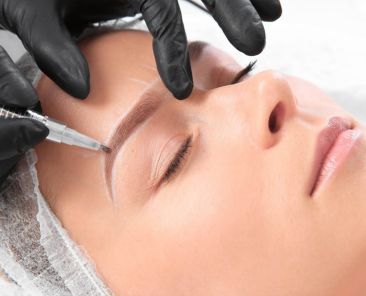
In the canalization phase, sapphire micro blades are used, which cause minimal damage to the tissue. These blades are held at an angle of 10-15 degrees, almost tangential to the skin, and the direction of the channels is determined.
Secondly, Long FUE Eyebrow Transplant golden ratio design By adhering to its principles, transplantation is performed by preserving the original length of the hairs. Long hair strands act as a guide during transplantation. The physician immediately sees the graft lying on the skin and can immediately correct the angle if the hair is standing upright.
Angle and Direction Analysis by Eyebrow Regions
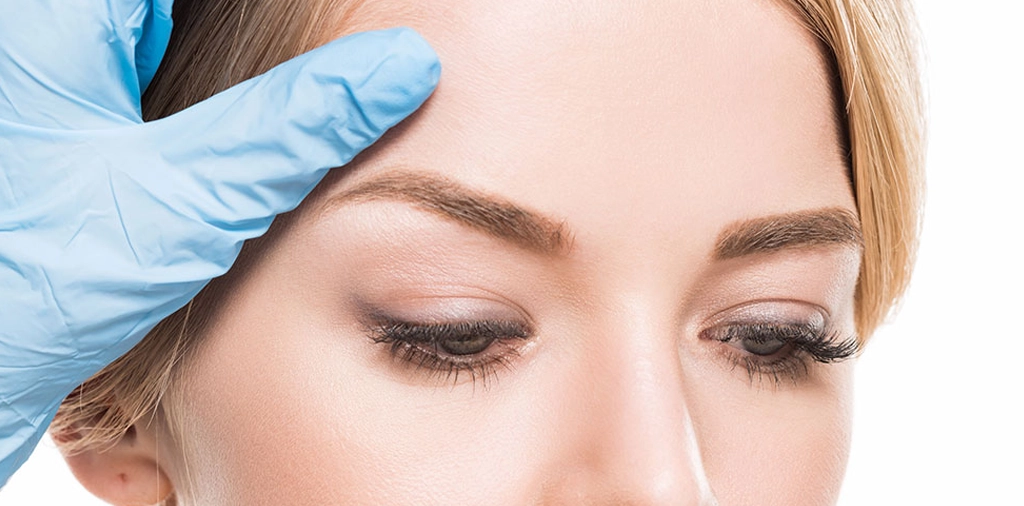
In order for the eyebrow to look homogeneous and natural, it is a big mistake to transplant the entire eyebrow with a single angle. The following table summarizes the ideal angulation criteria that should be applied in different parts of the eyebrow and the risks of steep growth in these areas:
| Kas Region | Natural Exit Angle (Degree) | Natural Growth Direction | The Problem of Erroneous Sowing |
|---|---|---|---|
| Start (Medial) | 15 - 20° | Vertical, slightly inclined upwards | Hairs standing upright and separated towards the center of the forehead |
| Body | 10 - 12° | Horizontal, parallel to the temples and interlaced | Bristles shoot directly forward (Hedgehog image) |
| Tail | 5 - 10° | Horizontal at a very acute angle downwards and towards the temples | Tail lifting, artificial appearance |
As can be seen in the table, especially the eyebrow shaft and tail are the areas with the highest risk of steep growth. Obtaining hairs that grow almost adherent to the skin in these areas is only possible with high precision manual skill and advanced technological infrastructure.
Treatment and Correction Methods for Steep Eyebrows
If you have a problem with raised eyebrows due to an incorrect operation performed in another clinic, there is no need to despair. In our clinic, special revision programs are applied for such cases. The methods followed in the correction treatment are as follows:
- Micro Extraction (Retrieval): Thick roots that grow very steeply and have a completely wrong direction are removed one by one with the help of micro punches without damaging them under the skin. After these removed areas heal, replanting can be planned at the right angles.
- Thinning with Laser Hair Removal: The hair follicles standing in the wrong direction are permanently destroyed with finely tuned laser devices and the general appearance of the eyebrow is corrected.
- Mechanical Routing and Lamination: In mild angle errors, eyebrow lamination or special fixing gels are used to try to make the hairs lie on the skin. However, this is a temporary solution.
After revision procedures in our patients natural looking eyebrow transplant In order to achieve the standards of the Long FUE method, new, thin roots are added at the right angles. Thus, the traces of past bad experiences are completely erased.
The Effect of Steep Eyebrows on Daily Life
Upright eyebrows are not just a detail noticed in photographs. When the hairs are planted at right angles to the skin, you have to make an extra effort every day to tilt your eyebrows in the morning. Over time, this becomes a tiring routine.
Our patients usually present with the complaint “my eyebrows won't lie down”. The hairs, which are temporarily shaped with gel or soap, become erect again during the day.
With a correct angle, your eyebrows grow in their natural direction and do not require any special care. Our priority is to create an eyebrow structure that does not force you to struggle with the mirror every morning and that looks good even when left to its own devices.
Design Principles to Reduce the Risk of Steep Eyebrows
The way to prevent the problem of steep eyebrows is through meticulous angle planning before transplantation. Each part of the eyebrow requires a different direction of emergence; the head extends upwards, the body extends to the side and the tail extends slightly downwards.
When planting without this directional map, the bristles are randomly oriented and the appearance of a brush is inevitable.
Since the natural curve of the hair can be seen during transplantation in methods using long roots, each root is placed in the right direction. Dr. Handan Yavuz constantly controls the angle throughout the transplantation, ensuring that the eyebrows grow down and naturally. Therefore, the design phase is as valuable to us as the operation itself.
Frequently Asked Questions
If the angle of the channel where the root is placed is steep, it is not possible for the hairs to recline spontaneously. However, the hairs that stand slightly upright in the first months may recline a little as the eyebrows grow and soften.
No, eyebrow lamination provides orientation by temporarily breaking the chemical bonds of the hairs. The effect lasts 4-6 weeks on average, after which the hairs return to their old vertical form.
There is no other donor area in the body that can produce eyebrow follicles. Hair follicles are structurally the closest alternative to the eyebrow; when selected and transplanted correctly, they adapt to the character of the eyebrow over time.
After an erroneous transplant, at least 6 to 9 months should be allowed for the skin and roots to heal completely. After this period, revision or retrieval operations can be safely performed.
Mechanical friction should be avoided for the first 10 days, and after the crusts fall off, the eyebrows should be combed regularly in the direction of natural growth to support the hairs to remain at the right angle.
Yes, thanks to their smooth surface, sapphire tips can enter the skin at much narrower angles, making it easier to keep the canals at the precisely planned 10-15 degree angle without tearing.
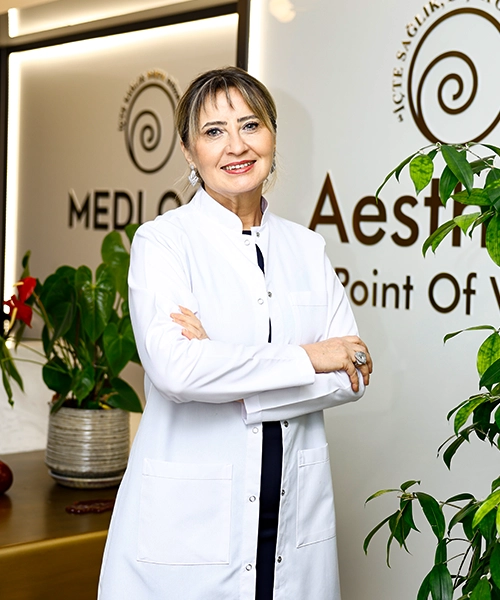
Dr. Handan Yavuz
MAKE AN APPOINTMENT