
What is FUT Eyebrow Transplant and How Did It Evolve?
 Dr. Handan YavuzKas Architect
10 min read
Dr. Handan YavuzKas Architect
10 min read
Contents
- A Stitched and Surgical Process: Challenges Awaiting the Patient
- Graft Separation Process and Laboratory Conditions in FUT Method
- Risks of Postoperative Donor Site Necrosis and Wound Separation (Dehiscence)
- Reasons for FUT Technique Failure in Eyebrow Aesthetics
- Modern Long FUE Comparison with FUT Method
- Historical Place of the FUT Method
- Most Common Regrets After FUT
- Current Options for Patients with FUT Scarring
- The Difference in Healing Comfort of FUT and Modern Methods
- Things to Ask When Deciding About FUT
- Modern Approaches in FUT Scar Revision
- Life After FUT Eyebrow Transplant and Modern Alternatives
- Frequently Asked Questions
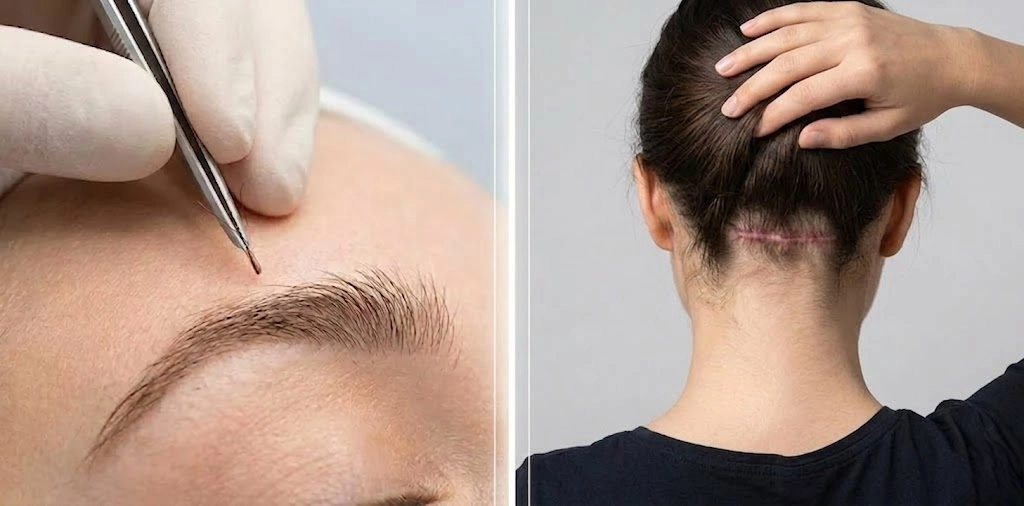
One of the first scientific steps in the history of hair and eyebrow restoration surgery FUT Eyebrow Transplant (Follicular Unit Transplantation) was considered the only solution and the gold standard in aesthetic medicine from the 1990s until the early 2000s. The basic surgical philosophy of this method is to cut and remove the scalp in the nape of the neck, which is genetically resistant to hair loss, as a ’strip’ of skin with the help of a scalpel. This strip of removed skin is divided into single or double hair follicles (“hair follicles”) by nurses or laboratory technicians under a microscope in the operation room with the help of a scalpel.follicular units) are separated and then transplanted into holes drilled in the eyebrow area.
As Istanbul Eyebrow Transplantation, we owe it to our patients to convey this technological evolution that the medical aesthetic world has undergone from past to present with our team led by Dr. Handan Yavuz in our Nişantaşı clinic. While answering the question of what is eyebrow transplantation today, we examine the scientific reasons why invasive and high surgical trauma methods such as FUT are now out of modern medical standards. While today's developing technologies offer stitch-free and painless solutions to our patients, the FUT method is now only accepted as a part of medical history.
FUT method In the early years, it was a compulsory choice because there was no way to remove the hair one by one. However, cutting out a large piece of flesh from the back of the neck to transplant an extremely sensitive area such as the eyebrow, where only a few hundred grafts are sufficient, is like digging the foundation of a building for a minor renovation. This high level of surgical trauma unnecessarily prolongs the patient's recovery and severely reduces their quality of life.
A Stitched and Surgical Process: Challenges Awaiting the Patient
The most important and negative feature that distinguishes the FUT method from today's advanced standards is that it involves a serious open surgical intervention. After the strip of skin tissue in the neck is cut with a scalpel, the large open wound is stretched and closed with sutures. This gives the patient the following serious disadvantages after the operation:
- Severe pain and a feeling of tension in the neck: After the skin strip is removed from the donor area, the edges of the skin are forced together with sutures. This causes a very serious tension in the neck, pain when turning the head left and right and sleep disturbances during the first 1-2 weeks after the operation. The need for painkillers is 3-4 times higher than FUE methods.
- Permanent Surgical Scar (Scar Tissue): In the stitched area, a horizontal surgical line (scar) remains, which is clearly visible from the outside when the hair is cut very short or gathered. This situation causes patients who have stitched eyebrow transplantation to have to hide the donor areas for life. This is an unacceptable aesthetic defect, especially for men who wear short hairstyles.
- Temporary or permanent numbness: When making a skin incision, the sensory nerves in the back of the neck are also cut with a scalpel. This leads to neurological complaints such as numbness, numbness or pins and needles in the donor area that last for months, sometimes permanently. This numbness deeply affects patients' daily comfort.
- Long and laborious suturing process: Approximately 10-14 days after the operation, the patient has to return to the clinic to have the stitches removed. This is one of the old method eyebrow transplant routines that increases the time cost and delays healing. The feeling of tension at the time of stitch removal also psychologically exhausts the patient.
Graft Separation Process and Laboratory Conditions in FUT Method
In the FUT technique, hair follicles are not harvested one by one directly from the ducts with the physician's manual skill. The skin ellipse of approximately 10-15 cm in length, which is cut out from the donor area, is taken to the laboratory table. Here, technicians working under surgical microscopes separate the skin into thin slices (slivers) with the help of a scalpel. The hair follicles in these slices are then extracted one by one with the help of tweezers and scalpel.
This manual dissection process greatly increases the risk of cutting and damaging the follicles (transection). A moment of fatigue or hand tremor on the part of the technician can cut the growth center of the hair follicle, rendering the graft completely dysfunctional. In addition, since the roots have to wait for a very long time in the external environment and outside of body temperature, they become metabolically weakened. In modern FUE methods, on the other hand, the roots are quickly transplanted as soon as they are harvested, almost without being kept outside, which maximizes their vitality rate.
Risks of Postoperative Donor Site Necrosis and Wound Separation (Dehiscence)
Since the FUT method involves a large incision and suturing procedure on the scalp, it invites many of the complications of classical general surgery. One of the most common risks is “wound dehiscence” (dehissans). If the patient suddenly tilts his/her head forward or makes a sudden neck movement after the operation, the tension on the sutures in the neck may increase excessively, causing the sutures to burst and the wound to open. The opened wound may need to be re-sutured, which increases the risk of infection.
Another frightening complication is “tissue necrosis” or skin death. When the skin of the neck is stretched and sutured, the capillaries in that area are compressed and the nutrition (perfusion) of the skin is disrupted. Without blood supply, the skin tissue blackens, dies and sheds.
This leads to large, balding and extremely ugly scars in the donor area. Dr. Handan Yavuz has completely stopped the application of the FUT method in our clinic due to such severe surgical risks and the traumatic healing phases that the patient will undergo after surgery.
Reasons for FUT Technique Failure in Eyebrow Aesthetics
The most important aesthetic flaw of the FUT method is the high risk of causing unnatural appearances in the eyebrow area. The grafts taken as strips from the nape of the neck usually contain thick and hard hair strands. While these roots are separated under a microscope, it is not possible to see the natural growth directions and curves of the hairs live.
For this reason, the transplanted hairs may be too thick in the eyebrow area and may grow steeply because their direction of growth cannot be controlled. Modern aesthetic surgery does not accept such artificialities in the eyebrow, which is the focal point of the face.
Over time, the medical world has found ways to harvest hair follicles without causing such surgical trauma to the patient. With the invention of the FUE (Follicular Unit Extraction) method, the skin cutting process came to an end. Today, the top step of this evolution Long FUE eyebrow transplant Thanks to this procedure, our patients are completely free from both stitches and having to cut their hair (shave) and get the eyebrows they dream of.
Modern Long FUE Comparison with FUT Method
You can see the structural and scientific differences between FUT, the old generation surgical method, and the premium unshaven Long FUE technique that our clinic focuses on in the table below:
| Comparison Criteria | FUT Method (Old Generation Stitched) | Long FUE Method (New Generation Unshaven) |
|---|---|---|
| Donor Site Preparation | Hair is shortened and skin is cut with a scalpel | No shaving or incisions, hair length is maintained |
| Suture and Surgical Scars | Horizontal suture scar on the back of the neck remains for life | Zero stitches, microscopic spots heal completely in 3 days |
| Pain After Procedure | High need for painkillers due to tension | Mild pain only the first night, almost no need for painkillers |
| Angle and Naturalness Control | Estimated placement due to short roots, risk is high | 100% accurate visual verification thanks to long hair strands |
| Integration into Social Life | At least 14 days for suture removal and recovery | The next day (Continuing business life and meetings without interruption) |
International Society of Hair Restoration Surgery (ISHRS) As noted in the sources, strip harvesting methods have largely been replaced by techniques based on follicular unit extraction.
Historical Place of the FUT Method
The FUT technique was developed in the early days of hair and eyebrow restoration because there was not yet a way to harvest individual follicles. It was an important step in its time, but the state of medicine now offers much less invasive options.
The basic rationale of the method was to take a strip of skin from the donor site and separate a graft from this piece. This approach creates a disproportionate surgical burden for a delicate area such as the eyebrow, which requires a small number of grafts.
Understanding FUT today is valuable to see why it was abandoned. Knowing the past allows us to make more informed choices today.
Most Common Regrets After FUT
The most common issue raised by patients who have undergone the procedure with the FUT method is the linear scar left on the nape of the neck. This scar can make it difficult to cut short hair or in some social settings.
The second common complaint is that the healing process is longer and less comfortable than expected. Caring for the suture site restricts daily life for a while.
When we listen to these experiences, we see that patients are actually more tired of the process itself than the result. Modern methods have been developed precisely to remove this burden.
Current Options for Patients with FUT Scarring
For patients who have had FUT in the past and have a scar on the back of their neck, various solutions are available today. The line can be largely camouflaged by root transplantation around the scar.
When a new eyebrow procedure is required, we prefer seamless, micro-root harvesting methods to prevent the formation of a second scar on the neck. Our aim is to move forward without repeating the mistakes of the past.
We evaluate each case on its own merits; some scars are better suited for planting, others for different approaches. We determine the right plan together by seeing your scar on site.
The Difference in Healing Comfort of FUT and Modern Methods
The most obvious disadvantage of the FUT method is the uncomfortable recovery period. The suture line in the nape of the neck creates tension and sensitivity in daily movements. Patients even have to pay attention to their lying position for a while.
In modern seamless methods, the intake points are millimetric and close spontaneously. This difference shortens the recovery time and speeds up the return to daily life.
Comfort is not just a convenience; it is also an element that increases adherence to treatment. A comfortable healing process makes the patient more willing to comply with care recommendations.
Things to Ask When Deciding About FUT
If you are still being offered FUT, we recommend that you clarify a few questions. It is your right to ask if there will be permanent scarring on the neck, how long the healing will take and why a less invasive option is not offered.
Is a major surgical intervention really necessary for an area that requires few grafts, such as the eyebrow? The answer to this question points to modern methods in most cases.
Asking informed questions is the first step to the right decision. We will discuss all the options transparently and evaluate together which method is right for you.
Modern Approaches in FUT Scar Revision
For patients who have had FUT in the past and have a prominent scar on the back of their neck, there are several improvement options available today. Micro-root transplantation around the scar line can significantly reduce its visibility.
In some cases, the quality of the scar tissue may not be suitable for transplantation; in this case, different camouflage methods are evaluated. Each scar is unique and requires a personalized plan rather than a standard solution.
When planning a new eyebrow procedure, it is a priority for us not to create a second scar on the neck. For this reason, we prefer seamless, micro-extraction-based methods and proceed without repeating the mistakes of the past.
Life After FUT Eyebrow Transplant and Modern Alternatives
The most common change that patients who have undergone FUT eyebrow transplantation feel in their daily life is the restriction in the nape area. The inability to cut short hair or the constant need to hide the area becomes tiring over time. This is an aspect of the FUT eyebrow transplantation method that affects the comfort of life as well as the aesthetic result.
Modern seamless methods eliminate this burden. Since there is no visible scar left behind in micro-excision procedures, the patient remains free in his/her hair and clothing preferences.
In patients with a history of FUT eyebrow transplantation, new planning is done according to the current permission status. Our aim is to achieve a natural result without repeating the discomfort of the past.
If FUT is still recommended, it is your right to ask why a less invasive alternative is not offered. We will discuss all the options transparently together to find the right method.
While FUT eyebrow transplantation was an important step forward in its time, for an area as delicate as the eyebrow, it is an approach that has been left behind today. Modern techniques without stitches and shaving offer much stronger options in terms of both healing comfort and natural result. Knowing the methods of the past allows you to make a more informed choice today. Together, we will discuss all options transparently and determine the best way for you.
Related guide: FUT Eyebrow Transplantation Errors.
Frequently Asked Questions
Is the FUT method still used today?
The majority of modern and innovative aesthetic clinics worldwide have completely abandoned the FUT method. However, it can be used as an old alternative in very rare cases of hair transplantation where the donor area is too limited or too weak to take follicles with the FUE method. It is almost never preferred in eyebrow transplantation.
Should eyebrow transplantation with FUT be preferred because the price is cheap?
Absolutely not. Although the cost of the procedure may seem low, leaving a surgical scar on your neck that you will carry for life, the risk of nerve damage and artificial images that may occur in the eyebrow area carry permanent aesthetic and health risks that are not worth this cheapness.
I had FUT before and there is a scar on my neck, can this scar be covered?
Yes, it is possible. Individual hair follicles can be transplanted on the old FUT surgery scar on the back of the neck using the FUE technique. Thanks to this transplantation, the scar is completely camouflaged by the hair growth and the scar is made invisible.
When are the stitches removed in the FUT method?
In the FUT technique, the removal of the stitches in the neck is usually performed 10 to 14 days after the operation, depending on the healing rate of the wound. The patient may feel a slight tension during the stitch removal process.
Why does Istanbul Eyebrow Transplant only perform FUE-based techniques?
Because our clinic adopts the goal of “natural and permanent eyebrow architecture”. We do not apply any old techniques that cause surgical trauma to our patients, leave scars and leave naturalness to chance; we focus on the most advanced and comfortable method, the unshaven Long FUE technique.
Why is the risk of infection higher after the FUT method than after FUE?
In FUT, a large, linear open wound is created in the nape of the neck and sutured. The contact of open wounds with the external environment is much more prone to infection than micro-point FUE channels. Therefore, postoperative sterility control and antibiotic treatment are much stricter.
How many grafts can be transplanted with the FUT method?
Depending on the size of the skin strip taken from the nape of the neck with the FUT method, 1500 to 2500 grafts (hair follicles) can be obtained in a single session. However, while this number is meaningful for hair transplantation, it is not medically logical to remove such a large piece of skin in eyebrow transplantation, where an average of 300-400 grafts is sufficient.